Apache Arrow
Apache Arrow is a cross-language development platform for in-memory data. At its core, Arrow defines a standardized, language-independent columnar memory format for flat and hierarchical data. This standard allows different data processing engines, languages, and tools to share, process, and transfer massive analytical datasets without the crippling overhead of serialization and deserialization. In the modern data ecosystem, Apache Arrow is rapidly becoming the foundational memory fabric connecting the open data lakehouse.
The Serialization Bottleneck
To understand why Arrow was created, one must understand the problem of data serialization.
Historically, every database, programming language, and processing engine (e.g., Python Pandas, Java-based Apache Spark, C++ based DuckDB) managed data in its own proprietary in-memory format.
If a data engineer wanted to read a dataset using Python, pass that data to Spark for heavy distributed processing, and then return the results to Python for machine learning, the data had to be converted. The Python data had to be serialized (converted into a common, intermediary format or byte stream), sent over a network or socket, and then deserialized (reconstructed) into Spark’s internal Java format.
In big data workflows, this serialization/deserialization (SerDe) process is incredibly CPU-intensive. It is estimated that in complex multi-system pipelines, up to 70-80% of CPU time is wasted simply converting data back and forth between different proprietary formats rather than actually performing analytical math.
The Arrow Solution: Zero-Copy Reads
Apache Arrow solves this by providing a standardized, columnar memory format that everyone agrees to use.
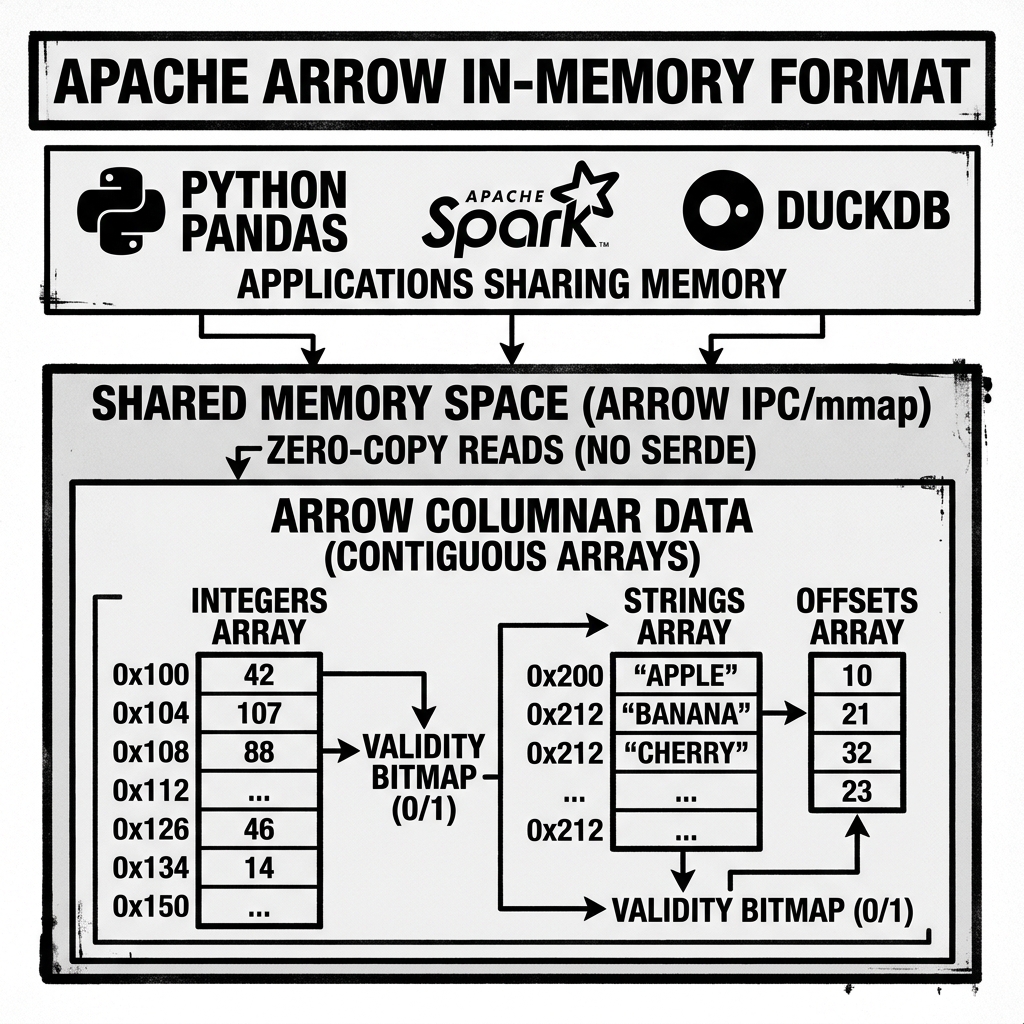
If Python Pandas, Apache Spark, and a database engine all natively support Apache Arrow, they can share data using Zero-Copy Reads. Because the data is already in a format that the receiving system understands natively, no serialization or deserialization is required.
Instead of copying and converting the data, the systems can simply pass a memory pointer. Python can allocate a gigabyte of memory, populate it with an Arrow table, and pass the memory address to a C++ library. The C++ library can instantly begin executing mathematical operations on that exact same block of memory. This eliminates the 80% CPU overhead associated with SerDe, resulting in massive, orders-of-magnitude performance increases for inter-system communication.
Designed for Vectorized Execution
Beyond sharing data, Arrow’s memory layout is explicitly designed for blistering performance on modern CPUs.
Arrow is a columnar memory format. Instead of storing data row-by-row (an Employee object containing an ID, Name, and Salary), it stores data as contiguous arrays of columns (an array of 10,000 IDs, an array of 10,000 Names, an array of 10,000 Salaries).
This memory layout perfectly aligns with Vectorized Execution and SIMD (Single Instruction, Multiple Data) processing. Because a column like “Salary” consists of contiguous, identical data types (e.g., 64-bit integers) sitting right next to each other in RAM, the CPU can load massive chunks of that data into its high-speed L1/L2 caches and execute mathematical operations on dozens of values simultaneously in a single clock cycle.
Arrow in the Lakehouse
Apache Arrow is not a storage format like Parquet or Iceberg; it is an in-memory format. However, its synergy with the lakehouse is profound.
When a query engine like Dremio or DuckDB reads a Parquet file from Amazon S3, it immediately converts that data into Apache Arrow format in its local RAM. All subsequent filtering, joining, and aggregating operations are performed on the Arrow data using vectorized execution.
Furthermore, the ecosystem around Arrow is expanding rapidly. Libraries like Arrow Flight allow for the transmission of Arrow data over the network at speeds vastly exceeding traditional ODBC/JDBC connections.
Summary and Tradeoffs
Apache Arrow is arguably the most important foundational technology developed for analytical computing in the last decade. By providing a universal, highly optimized, language-agnostic memory format, it is breaking down the silos between different big data tools and enabling a new generation of composable, lightning-fast data architectures.
The primary tradeoff with Apache Arrow is that it is heavily optimized for analytical (OLAP) workloads, where reading massive columns of data is the primary goal. It is not designed for transactional (OLTP) workloads that require frequent, random insertions or updates of single rows. Additionally, building applications that natively utilize Arrow requires a deep understanding of low-level memory management and columnar data structures, making the learning curve steeper for developers accustomed to traditional row-based object-oriented programming.
Visual Architecture