Arrow Flight SQL
Arrow Flight SQL is a protocol extension built on top of the Apache Arrow Flight framework. While the original Arrow Flight protocol provided a blazingly fast mechanism for transferring raw columnar data across a network, it lacked a standardized way to actually query that data. Arrow Flight SQL bridges this gap, establishing a universal, high-performance standard for clients (like BI tools or database drivers) to execute SQL queries against remote databases and retrieve the results in the highly optimized Arrow columnar format.
The Problem with Base Arrow Flight
The base Apache Arrow Flight protocol is incredibly fast because it eliminates serialization overhead. However, its core API is somewhat generic. A Flight Client can ask a Flight Server for a specific dataset (often identified by a “ticket” or an opaque byte string), but the protocol itself does not mandate how the client asks for it.
If a data scientist wanted to send a complex SQL query like SELECT region, SUM(sales) FROM table GROUP BY region using base Arrow Flight, they had to implement custom logic. The client and the server had to agree on a proprietary way to package the SQL string inside the Flight request.
This lack of standardization meant that base Arrow Flight could not easily replace universal protocols like ODBC or JDBC, which have well-defined, standardized mechanisms for executing SQL, fetching metadata, and managing database sessions.
The Flight SQL Standard
Arrow Flight SQL solves this by defining a strict, standardized set of RPC (Remote Procedure Call) commands on top of the Arrow Flight framework specifically tailored for relational database interactions.
Flight SQL defines standard mechanisms for:
- Executing SQL Commands: A standardized way for a client to send a SQL query string to the server.
- Prepared Statements: The ability to pre-compile SQL queries for faster, repeated execution with varying parameters.
- Database Metadata Retrieval: Standardized commands to query the database catalog, allowing BI tools to discover available schemas, tables, columns, and data types automatically.
- Transaction Management: (In newer iterations) Mechanisms to begin, commit, and roll back database transactions.
The Best of Both Worlds
Arrow Flight SQL represents a “best of both worlds” scenario for the modern data lakehouse.
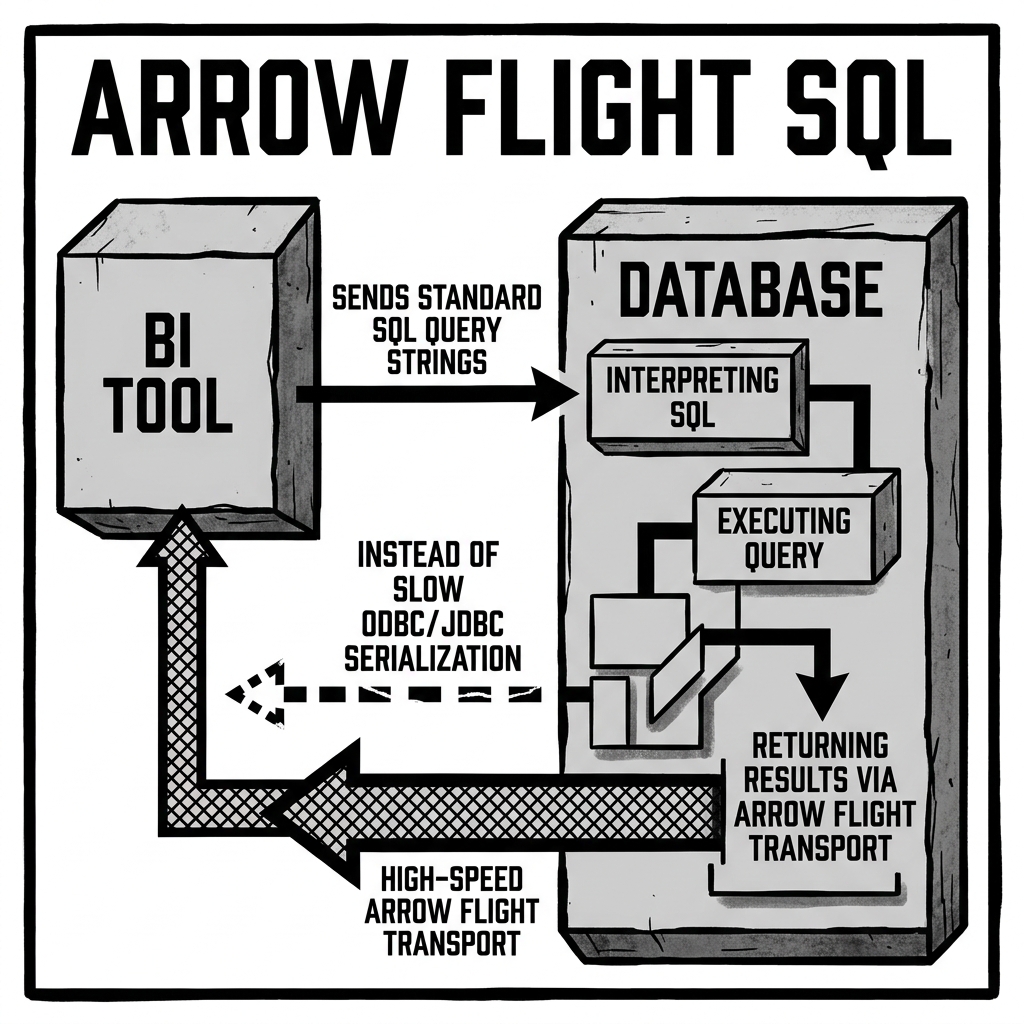
It retains the universal compatibility of legacy protocols. Because Flight SQL standardizes how SQL and metadata are handled, vendors can write generic Arrow Flight SQL ODBC or JDBC drivers. A user can plug this driver into Tableau, PowerBI, or DBeaver. The BI tool sends standard SQL strings through the driver, completely unaware of the underlying technology.
However, beneath the surface, it retains the blistering speed of Apache Arrow. When the database server (e.g., Dremio or DuckDB) executes the query, it does not serialize the results cell-by-cell into a slow, row-based format. It streams the results back to the driver as highly compressed, zero-copy Arrow RecordBatches over gRPC.
This allows organizations to drop Arrow Flight SQL drivers into their existing BI ecosystems and immediately experience massive performance gains—often retrieving large datasets 10x to 50x faster than traditional connections.
Flight SQL in the Lakehouse Ecosystem
The adoption of Arrow Flight SQL is accelerating rapidly in the open data ecosystem.
Modern query engines designed around columnar, vectorized execution (like Dremio) use Flight SQL as their primary interface for high-performance data extraction. It allows these engines to serve massive datasets to downstream consumers (like Python machine learning environments or caching layers) without the network transfer becoming the bottleneck.
Furthermore, because it is an open standard maintained by the Apache Software Foundation, it prevents the industry from fracturing into dozens of proprietary, vendor-specific high-speed transport protocols.
Summary and Tradeoffs
Arrow Flight SQL is the modern successor to ODBC and JDBC for analytical workloads. By marrying the universal applicability of SQL with the zero-serialization speed of the Arrow in-memory format, it provides the ultimate transport layer for the open data lakehouse.
The primary tradeoff with Arrow Flight SQL is that it is still a relatively new technology compared to the decades-old dominance of standard JDBC/ODBC. While open-source drivers exist, they are still maturing, and native support within proprietary BI tools is still growing. Additionally, the massive performance benefits of Flight SQL are most apparent when transferring very large result sets (millions of rows); for simple, single-row point lookups (OLTP workloads), the overhead of setting up the gRPC connection may not yield significant advantages over traditional protocols.
Visual Architecture