MinIO
MinIO is an open-source, high-performance, distributed object storage server. Built from the ground up to be fully compatible with the Amazon S3 API, MinIO is designed to run anywhere—from bare-metal servers in an on-premises data center to containerized deployments in public clouds via Kubernetes. In the context of the open data lakehouse, MinIO has become the defacto standard for organizations that want the scalable, decoupled architecture of a cloud data lake, but require the data to remain on-premises due to compliance, security, or network latency requirements.
Core Characteristics and S3 Compatibility
When Amazon S3 popularized object storage, it established its proprietary HTTP/REST API as the industry standard. However, S3 is a managed service tightly coupled to the AWS ecosystem. If an organization wanted an S3-like experience in their own private data center, they had few options.
MinIO was created to fill this exact void. It implements the Amazon S3 API exactly. From an application’s perspective, whether it is sending a PUT request to s3.amazonaws.com or to a local MinIO endpoint like minio.local:9000, the interaction is identical.
This strict API compatibility is incredibly powerful. It means that any data engineering tool, compute engine, or library built to work with AWS S3—such as Apache Spark, Trino, Dremio, Apache Iceberg, or the AWS CLI—works seamlessly with MinIO out of the box. Organizations can build and test their data pipelines locally using MinIO, and seamlessly deploy those exact same pipelines to AWS S3 in production without changing a single line of code.
High Performance and Cloud-Native Architecture
MinIO was written entirely in Go, prioritizing extreme performance and lightweight operation. Unlike legacy storage appliances that retrofitted object storage interfaces onto old file systems, MinIO is a pure object store designed for the modern era of NVMe drives and 100GbE networks.
MinIO frequently publishes benchmarks demonstrating read and write speeds that saturate high-end network interfaces, making it highly competitive with, and often faster than, public cloud storage when running on optimized bare-metal hardware. This blistering speed makes it an ideal storage backend for demanding analytical workloads and machine learning training pipelines.
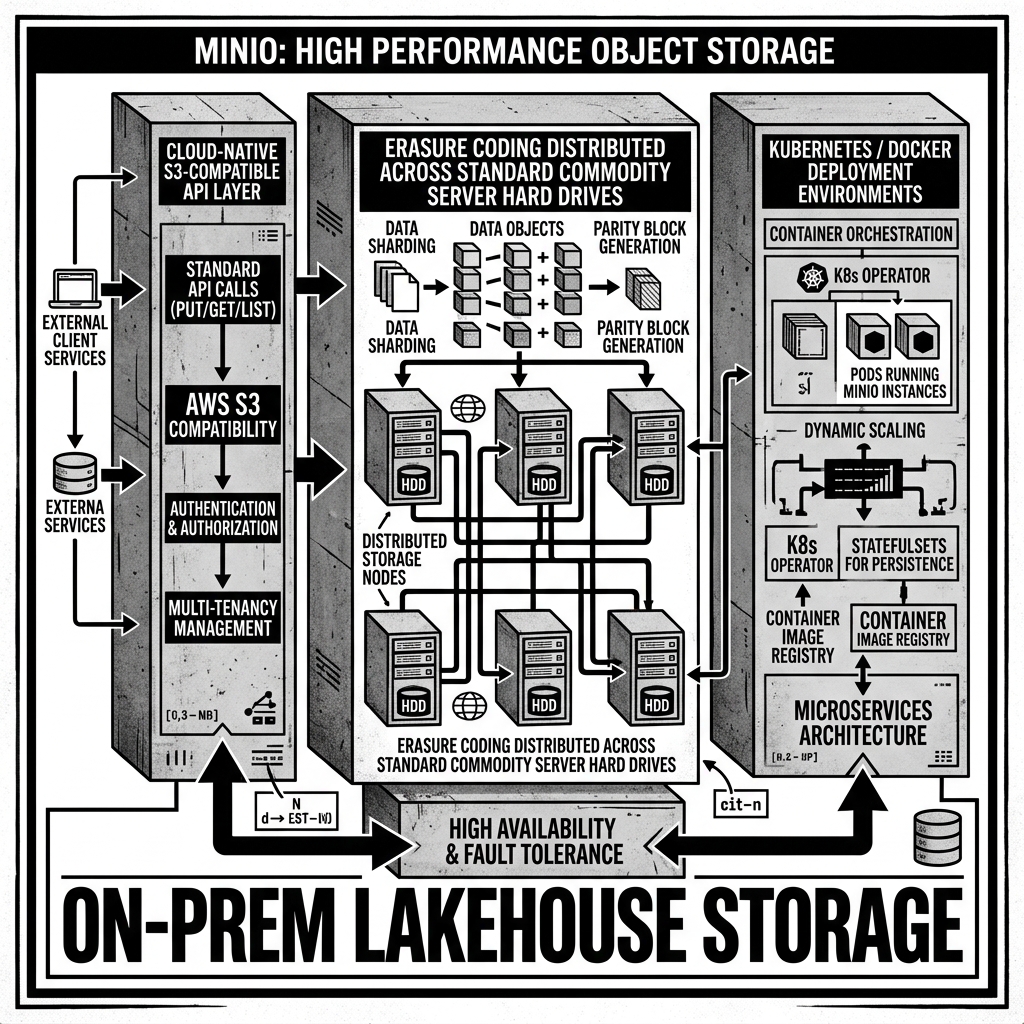
Furthermore, MinIO is fully cloud-native. It is designed to be deployed as a container within a Kubernetes cluster. The MinIO Kubernetes Operator allows infrastructure teams to provision, manage, and scale multi-tenant object storage clusters with the same declarative ease as provisioning compute microservices.
Erasure Coding and Data Protection
Public cloud providers like AWS provide durability by replicating data across multiple massive data centers. For an on-premises deployment, replicating data multiple times (e.g., keeping 3 copies of every file) is often prohibitively expensive in terms of hard drive costs.
MinIO achieves high durability and fault tolerance using a mathematical technique called Erasure Coding. Instead of making complete copies of a file, erasure coding breaks a file into data blocks and parity blocks. These blocks are distributed across the various hard drives and servers in the MinIO cluster.
Depending on the configuration, a MinIO cluster can lose up to half of its physical hard drives (or entire servers) and still seamlessly reconstruct the requested data on the fly using the parity blocks. This provides immense protection against hardware failure with a significantly lower storage overhead than traditional mirroring techniques. MinIO also implements bit-rot protection to silently detect and heal corrupted data blocks on disk.
Summary and Tradeoffs
MinIO democratized object storage by providing a highly performant, open-source, S3-compatible server that can run anywhere. It is the foundational layer for “private cloud” data lakehouses, allowing organizations to maintain physical control over their hardware and data without sacrificing the modern, decoupled architecture popularized by the public cloud.
The primary tradeoff with MinIO compared to a managed service like AWS S3 is the operational burden. With S3, AWS handles all hard drive failures, network routing, software patching, and physical security. When running MinIO on-premises, the organization’s IT infrastructure team is responsible for purchasing the servers, replacing dead hard drives, managing the Kubernetes networking, and ensuring the physical security of the data center.
However, for organizations operating at massive scale, repatriating data from the public cloud to an on-premises MinIO cluster can result in massive cost savings, avoiding the hefty data egress fees and per-GB storage costs associated with public cloud providers.
Visual Architecture