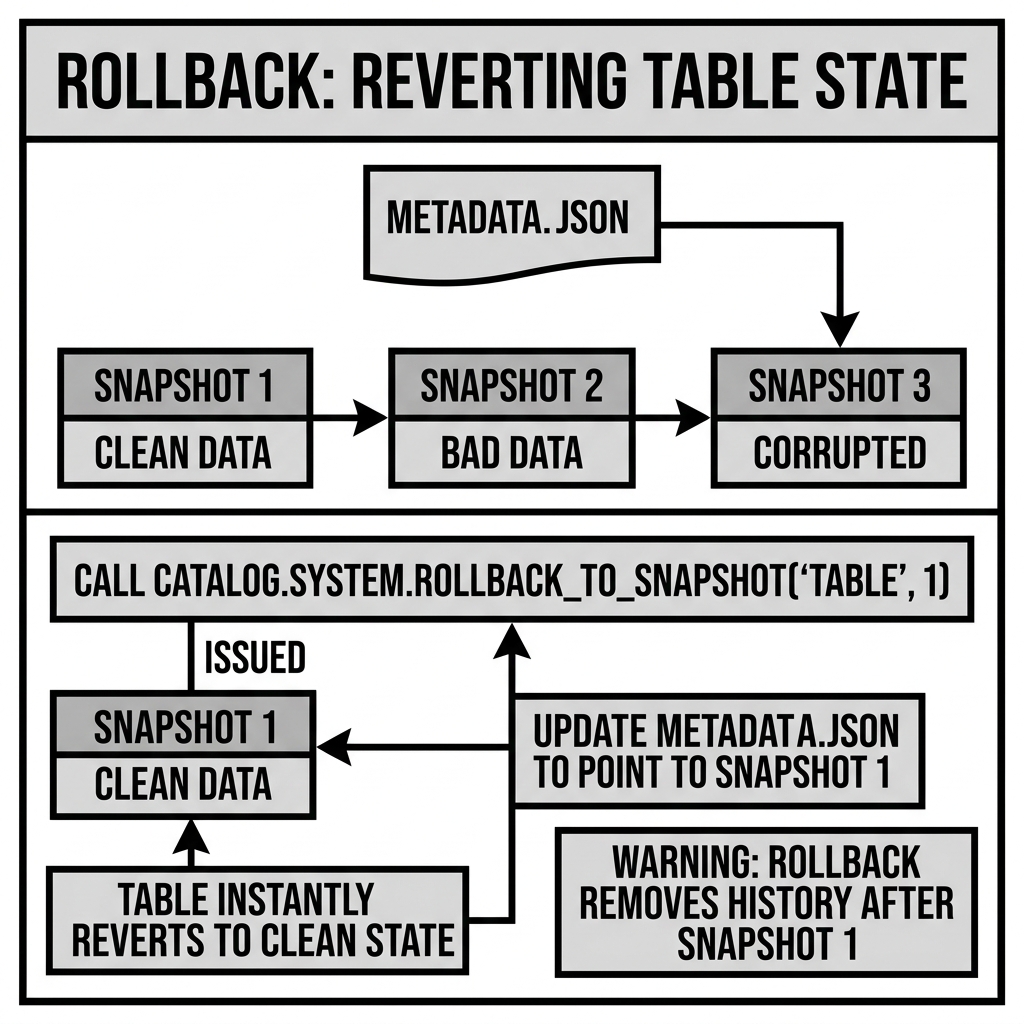
Rollback
Despite the best data quality checks and Write-Audit-Publish patterns, human error inevitably occurs in data engineering. A developer might execute a massive DELETE statement without a WHERE clause, instantly wiping out millions of critical records from a production table.
In a traditional relational database, recovering from this disaster usually requires finding the previous night’s database backup, halting production, and spending hours restoring data from tape drives or slow cloud storage buckets.
In Apache Iceberg, recovering from this disaster takes less than a second, thanks to the Rollback operation.
Reversing the Pointer
Iceberg is designed around immutable files and Snapshot Isolation. When the disastrous DELETE statement executed, it did not physically destroy the old data files. Instead, it created a new Snapshot (e.g., Snapshot 101) that contained Delete Files to logically hide the records.
Because the previous state of the table is fully preserved in Snapshot 100, the data engineer simply executes an administrative command via Spark or their catalog’s UI to rollback the table.
The Iceberg Catalog performs an atomic operation: it swaps the active metadata pointer from Snapshot 101 back to Snapshot 100.
Instantly, any new queries arriving at the catalog are directed to the old snapshot. The deleted data reappears exactly as it was before the mistake. There is no physical data movement, no massive restore jobs, and virtually zero downtime.
Branching and Rollback Safety
Rollback is a blunt instrument. When you rollback the main branch to a state from 4 hours ago, you aren’t just reversing the disastrous DELETE statement—you are also undoing every valid streaming insert or batch update that occurred during those 4 hours.
For this reason, rolling back the main production branch is considered an emergency procedure. A safer pattern is to rely heavily on Branching, where destructive or complex operations are performed on a separate branch, allowing them to be audited (or discarded) before they ever touch the main production timeline.
(Diagram 1: An atomic rollback moving the catalog pointer to a previous snapshot - Pending Generation) (Diagram 2: Rollback restoring access to logically deleted data files - Pending Generation)
Visual Architecture