Run-Length Encoding (RLE)
Core Definition
Run-Length Encoding (RLE) is a simple, lossless data compression algorithm that excels at shrinking repetitive sequences of identical values. In the context of the open data lakehouse and columnar file formats (like Apache Parquet and ORC), RLE is frequently combined with Dictionary Encoding to achieve astronomical compression ratios, particularly on data that has been intentionally sorted.
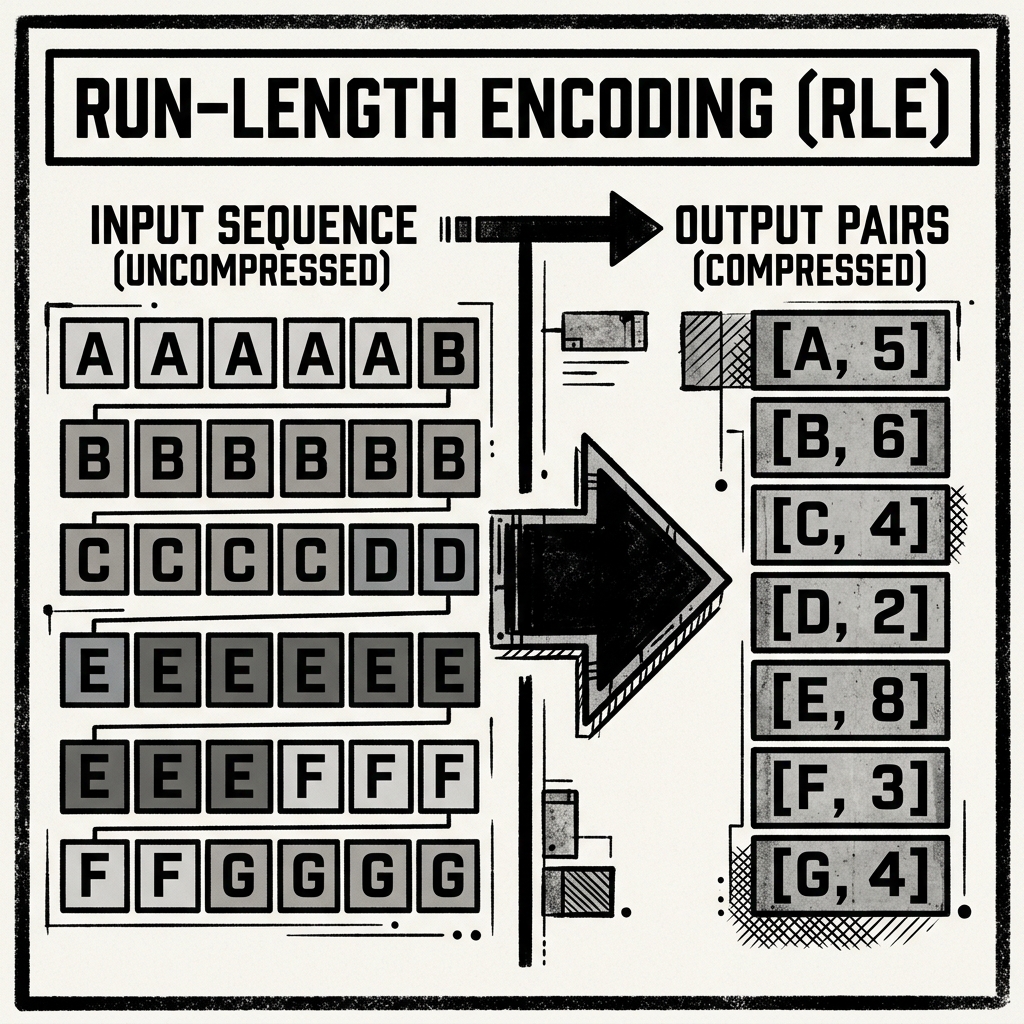
The fundamental concept of RLE is to replace a “run” (a sequence of consecutive identical data points) with a single instance of the data value and a count of how many times it repeats.
Diagram 1: Conceptual Architecture
Implementation and Operations
Imagine a columnar dataset representing the hourly status of an IoT sensor over a week. The status might be the string “ACTIVE” repeated 5,000 times sequentially, followed by “INACTIVE” 10 times, followed by “ACTIVE” another 5,000 times.
Instead of storing 10,010 individual strings, RLE compresses this into three simple pairs:
- (“ACTIVE”, 5000)
- (“INACTIVE”, 10)
- (“ACTIVE”, 5000)
This takes a massive block of data and reduces it to a few bytes.
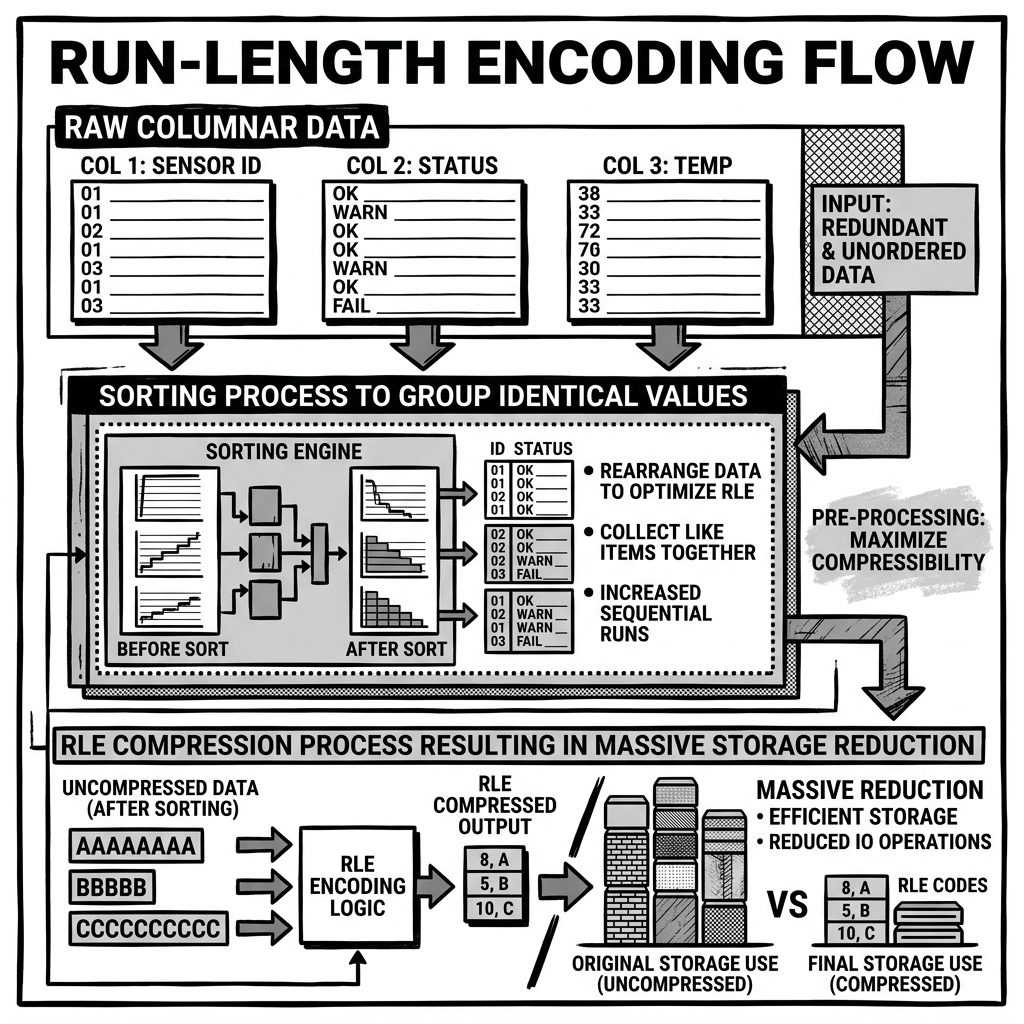
In modern big data formats, RLE is almost never used on raw strings. Instead, it is used on the integer streams produced by Dictionary Encoding. If a column is dictionary encoded, and the data is sorted by that column, the resulting integer stream will look like 0, 0, 0, 0, 0, 1, 1, 1, 2, 2, 2, 2.
Applying RLE to this integer stream results in (0, 5), (1, 3), (2, 4). This combination of Dictionary Encoding followed by RLE is why sorting your data before writing it to a data lake (using techniques like Z-Ordering or simple ORDER BY clauses during ETL) is one of the most critical performance tuning steps a data engineer can take.
Diagram 2: Operational Flow
Summary and Tradeoffs
RLE is incredibly powerful but highly situational. The primary tradeoff is that RLE is completely useless—and can actually increase file sizes—if the data is highly varied and not sorted. If a column alternates values rapidly (e.g., 0, 1, 0, 1, 0, 1), RLE will attempt to store it as (0,1), (1,1), (0,1), effectively doubling the required storage. Therefore, Parquet and ORC writers use sophisticated heuristics to determine on the fly whether RLE will be beneficial for a specific data page, applying it only when profitable.
Extended Deep Dive: The Data Engineering Ecosystem
To truly understand this concept, it must be placed within the broader context of the modern data engineering ecosystem. The evolution from traditional, monolithic on-premises data warehouses to decoupled, cloud-native open data lakehouses represents one of the most significant paradigm shifts in software architecture over the last two decades.
The Problem with Legacy Data Warehouses
Historically, organizations relied on proprietary appliances from vendors like Teradata, Oracle, or IBM. These systems were characterized by a tight coupling of compute and storage. The data physically resided on the hard drives of the specific servers that executed the SQL queries. While incredibly fast for structured, relational data, this architecture suffered from fatal scalability flaws. If an organization needed more storage for historical logs, they were forced to purchase expensive, proprietary servers that included compute power they did not actually need. Furthermore, these systems struggled to ingest unstructured data (like raw JSON, images, or massive IoT streams), creating impenetrable data silos.
The Rise and Fall of the Data Lake (Hadoop)
To solve the volume and variety problem, the industry pivoted to the Data Lake, pioneered by Apache Hadoop. Organizations began dumping all raw data—structured, semi-structured, and unstructured—into the Hadoop Distributed File System (HDFS). Because HDFS ran on cheap commodity hardware, storage became essentially free. However, the data lake lacked the basic governance, transactional guarantees, and performance optimization of the data warehouse. Without ACID (Atomicity, Consistency, Isolation, Durability) transactions, concurrent reads and writes frequently corrupted data. Without schema enforcement, the data lake quickly devolved into an unmanageable, unqueryable “data swamp.”
The Open Data Lakehouse Paradigm
The open data lakehouse merges the best of both worlds. It utilizes the infinitely scalable, low-cost storage of the cloud (like Amazon S3 or Google Cloud Storage) but overlays the management and performance features of a traditional data warehouse.
This is achieved through a multi-layered architecture:
- The Storage Layer: Cloud object storage provides the infinite hard drive.
- The File Format Layer: Open columnar formats like Apache Parquet and ORC provide extreme compression and analytical read efficiency.
- The Table Format Layer: Technologies like Apache Iceberg, Delta Lake, and Apache Hudi sit on top of the physical files. They provide the metadata layer that enables ACID transactions, schema evolution, and time travel, bringing warehouse-level reliability to the raw object storage.
- The Compute Layer: Decoupled, highly elastic engines like Trino, Dremio, Apache Spark, and Snowflake sit at the top. They can be scaled up or down independently of the storage, providing massive parallel processing power only when queries are actively running.
Performance Optimization Strategies
In this decoupled architecture, network bandwidth between the compute engine and the object storage is the primary bottleneck. Data engineers employ a variety of advanced strategies to minimize this I/O:
- Partitioning: Organizing data into distinct directories based on a frequently queried column (e.g., separating data by
year/month/day). When an analyst queries a specific date, the engine simply ignores all directories that do not match, massively reducing data reads. - Z-Ordering and Space-Filling Curves: Advanced sorting techniques that cluster multi-dimensional data physically close together on the disk. This dramatically improves the effectiveness of file-skipping statistics (Min/Max filtering) in formats like Iceberg, allowing engines to read highly targeted, microscopic subsets of massive tables.
- Compaction: Over time, streaming ingestions create millions of tiny, inefficient files. Data engineers run scheduled compaction jobs (often utilizing bin-packing algorithms) to merge these tiny files into optimally sized, large columnar blocks (typically 128MB to 512MB), restoring query performance and reducing S3 API overhead.
Security and Governance
As data is democratized across the enterprise, governance becomes paramount. The open lakehouse relies on centralized metadata catalogs (like AWS Glue, Apache Polaris, or Unity Catalog) to manage access. Fine-Grained Access Control (FGAC) allows administrators to mask specific columns (like Social Security Numbers) or restrict specific rows based on the user’s role, ensuring that a single, unified dataset can be securely queried by marketing, finance, and engineering teams simultaneously without violating compliance regulations like GDPR or CCPA.
Conclusion
The architecture described above is not static. The industry is rapidly moving toward real-time streaming ingestion, automated “agentic” data modeling, and universal cross-engine compatibility via projects like Apache XTable. Understanding the foundational layers—how data is serialized, compressed, stored, and transported—is the absolute prerequisite for architecting systems that can handle the exabyte-scale analytics demands of the future.
Extended Deep Dive: The Data Engineering Ecosystem
To truly understand this concept, it must be placed within the broader context of the modern data engineering ecosystem. The evolution from traditional, monolithic on-premises data warehouses to decoupled, cloud-native open data lakehouses represents one of the most significant paradigm shifts in software architecture over the last two decades.
The Problem with Legacy Data Warehouses
Historically, organizations relied on proprietary appliances from vendors like Teradata, Oracle, or IBM. These systems were characterized by a tight coupling of compute and storage. The data physically resided on the hard drives of the specific servers that executed the SQL queries. While incredibly fast for structured, relational data, this architecture suffered from fatal scalability flaws. If an organization needed more storage for historical logs, they were forced to purchase expensive, proprietary servers that included compute power they did not actually need. Furthermore, these systems struggled to ingest unstructured data (like raw JSON, images, or massive IoT streams), creating impenetrable data silos.
The Rise and Fall of the Data Lake (Hadoop)
To solve the volume and variety problem, the industry pivoted to the Data Lake, pioneered by Apache Hadoop. Organizations began dumping all raw data—structured, semi-structured, and unstructured—into the Hadoop Distributed File System (HDFS). Because HDFS ran on cheap commodity hardware, storage became essentially free. However, the data lake lacked the basic governance, transactional guarantees, and performance optimization of the data warehouse. Without ACID (Atomicity, Consistency, Isolation, Durability) transactions, concurrent reads and writes frequently corrupted data. Without schema enforcement, the data lake quickly devolved into an unmanageable, unqueryable “data swamp.”
The Open Data Lakehouse Paradigm
The open data lakehouse merges the best of both worlds. It utilizes the infinitely scalable, low-cost storage of the cloud (like Amazon S3 or Google Cloud Storage) but overlays the management and performance features of a traditional data warehouse.
This is achieved through a multi-layered architecture:
- The Storage Layer: Cloud object storage provides the infinite hard drive.
- The File Format Layer: Open columnar formats like Apache Parquet and ORC provide extreme compression and analytical read efficiency.
- The Table Format Layer: Technologies like Apache Iceberg, Delta Lake, and Apache Hudi sit on top of the physical files. They provide the metadata layer that enables ACID transactions, schema evolution, and time travel, bringing warehouse-level reliability to the raw object storage.
- The Compute Layer: Decoupled, highly elastic engines like Trino, Dremio, Apache Spark, and Snowflake sit at the top. They can be scaled up or down independently of the storage, providing massive parallel processing power only when queries are actively running.
Performance Optimization Strategies
In this decoupled architecture, network bandwidth between the compute engine and the object storage is the primary bottleneck. Data engineers employ a variety of advanced strategies to minimize this I/O:
- Partitioning: Organizing data into distinct directories based on a frequently queried column (e.g., separating data by
year/month/day). When an analyst queries a specific date, the engine simply ignores all directories that do not match, massively reducing data reads. - Z-Ordering and Space-Filling Curves: Advanced sorting techniques that cluster multi-dimensional data physically close together on the disk. This dramatically improves the effectiveness of file-skipping statistics (Min/Max filtering) in formats like Iceberg, allowing engines to read highly targeted, microscopic subsets of massive tables.
- Compaction: Over time, streaming ingestions create millions of tiny, inefficient files. Data engineers run scheduled compaction jobs (often utilizing bin-packing algorithms) to merge these tiny files into optimally sized, large columnar blocks (typically 128MB to 512MB), restoring query performance and reducing S3 API overhead.
Security and Governance
As data is democratized across the enterprise, governance becomes paramount. The open lakehouse relies on centralized metadata catalogs (like AWS Glue, Apache Polaris, or Unity Catalog) to manage access. Fine-Grained Access Control (FGAC) allows administrators to mask specific columns (like Social Security Numbers) or restrict specific rows based on the user’s role, ensuring that a single, unified dataset can be securely queried by marketing, finance, and engineering teams simultaneously without violating compliance regulations like GDPR or CCPA.
Conclusion
The architecture described above is not static. The industry is rapidly moving toward real-time streaming ingestion, automated “agentic” data modeling, and universal cross-engine compatibility via projects like Apache XTable. Understanding the foundational layers—how data is serialized, compressed, stored, and transported—is the absolute prerequisite for architecting systems that can handle the exabyte-scale analytics demands of the future.
Extended Deep Dive: The Data Engineering Ecosystem
To truly understand this concept, it must be placed within the broader context of the modern data engineering ecosystem. The evolution from traditional, monolithic on-premises data warehouses to decoupled, cloud-native open data lakehouses represents one of the most significant paradigm shifts in software architecture over the last two decades.
The Problem with Legacy Data Warehouses
Historically, organizations relied on proprietary appliances from vendors like Teradata, Oracle, or IBM. These systems were characterized by a tight coupling of compute and storage. The data physically resided on the hard drives of the specific servers that executed the SQL queries. While incredibly fast for structured, relational data, this architecture suffered from fatal scalability flaws. If an organization needed more storage for historical logs, they were forced to purchase expensive, proprietary servers that included compute power they did not actually need. Furthermore, these systems struggled to ingest unstructured data (like raw JSON, images, or massive IoT streams), creating impenetrable data silos.
The Rise and Fall of the Data Lake (Hadoop)
To solve the volume and variety problem, the industry pivoted to the Data Lake, pioneered by Apache Hadoop. Organizations began dumping all raw data—structured, semi-structured, and unstructured—into the Hadoop Distributed File System (HDFS). Because HDFS ran on cheap commodity hardware, storage became essentially free. However, the data lake lacked the basic governance, transactional guarantees, and performance optimization of the data warehouse. Without ACID (Atomicity, Consistency, Isolation, Durability) transactions, concurrent reads and writes frequently corrupted data. Without schema enforcement, the data lake quickly devolved into an unmanageable, unqueryable “data swamp.”
The Open Data Lakehouse Paradigm
The open data lakehouse merges the best of both worlds. It utilizes the infinitely scalable, low-cost storage of the cloud (like Amazon S3 or Google Cloud Storage) but overlays the management and performance features of a traditional data warehouse.
This is achieved through a multi-layered architecture:
- The Storage Layer: Cloud object storage provides the infinite hard drive.
- The File Format Layer: Open columnar formats like Apache Parquet and ORC provide extreme compression and analytical read efficiency.
- The Table Format Layer: Technologies like Apache Iceberg, Delta Lake, and Apache Hudi sit on top of the physical files. They provide the metadata layer that enables ACID transactions, schema evolution, and time travel, bringing warehouse-level reliability to the raw object storage.
- The Compute Layer: Decoupled, highly elastic engines like Trino, Dremio, Apache Spark, and Snowflake sit at the top. They can be scaled up or down independently of the storage, providing massive parallel processing power only when queries are actively running.
Performance Optimization Strategies
In this decoupled architecture, network bandwidth between the compute engine and the object storage is the primary bottleneck. Data engineers employ a variety of advanced strategies to minimize this I/O:
- Partitioning: Organizing data into distinct directories based on a frequently queried column (e.g., separating data by
year/month/day). When an analyst queries a specific date, the engine simply ignores all directories that do not match, massively reducing data reads. - Z-Ordering and Space-Filling Curves: Advanced sorting techniques that cluster multi-dimensional data physically close together on the disk. This dramatically improves the effectiveness of file-skipping statistics (Min/Max filtering) in formats like Iceberg, allowing engines to read highly targeted, microscopic subsets of massive tables.
- Compaction: Over time, streaming ingestions create millions of tiny, inefficient files. Data engineers run scheduled compaction jobs (often utilizing bin-packing algorithms) to merge these tiny files into optimally sized, large columnar blocks (typically 128MB to 512MB), restoring query performance and reducing S3 API overhead.
Security and Governance
As data is democratized across the enterprise, governance becomes paramount. The open lakehouse relies on centralized metadata catalogs (like AWS Glue, Apache Polaris, or Unity Catalog) to manage access. Fine-Grained Access Control (FGAC) allows administrators to mask specific columns (like Social Security Numbers) or restrict specific rows based on the user’s role, ensuring that a single, unified dataset can be securely queried by marketing, finance, and engineering teams simultaneously without violating compliance regulations like GDPR or CCPA.
Conclusion
The architecture described above is not static. The industry is rapidly moving toward real-time streaming ingestion, automated “agentic” data modeling, and universal cross-engine compatibility via projects like Apache XTable. Understanding the foundational layers—how data is serialized, compressed, stored, and transported—is the absolute prerequisite for architecting systems that can handle the exabyte-scale analytics demands of the future.
Extended Deep Dive: The Data Engineering Ecosystem
To truly understand this concept, it must be placed within the broader context of the modern data engineering ecosystem. The evolution from traditional, monolithic on-premises data warehouses to decoupled, cloud-native open data lakehouses represents one of the most significant paradigm shifts in software architecture over the last two decades.
The Problem with Legacy Data Warehouses
Historically, organizations relied on proprietary appliances from vendors like Teradata, Oracle, or IBM. These systems were characterized by a tight coupling of compute and storage. The data physically resided on the hard drives of the specific servers that executed the SQL queries. While incredibly fast for structured, relational data, this architecture suffered from fatal scalability flaws. If an organization needed more storage for historical logs, they were forced to purchase expensive, proprietary servers that included compute power they did not actually need. Furthermore, these systems struggled to ingest unstructured data (like raw JSON, images, or massive IoT streams), creating impenetrable data silos.
The Rise and Fall of the Data Lake (Hadoop)
To solve the volume and variety problem, the industry pivoted to the Data Lake, pioneered by Apache Hadoop. Organizations began dumping all raw data—structured, semi-structured, and unstructured—into the Hadoop Distributed File System (HDFS). Because HDFS ran on cheap commodity hardware, storage became essentially free. However, the data lake lacked the basic governance, transactional guarantees, and performance optimization of the data warehouse. Without ACID (Atomicity, Consistency, Isolation, Durability) transactions, concurrent reads and writes frequently corrupted data. Without schema enforcement, the data lake quickly devolved into an unmanageable, unqueryable “data swamp.”
The Open Data Lakehouse Paradigm
The open data lakehouse merges the best of both worlds. It utilizes the infinitely scalable, low-cost storage of the cloud (like Amazon S3 or Google Cloud Storage) but overlays the management and performance features of a traditional data warehouse.
This is achieved through a multi-layered architecture:
- The Storage Layer: Cloud object storage provides the infinite hard drive.
- The File Format Layer: Open columnar formats like Apache Parquet and ORC provide extreme compression and analytical read efficiency.
- The Table Format Layer: Technologies like Apache Iceberg, Delta Lake, and Apache Hudi sit on top of the physical files. They provide the metadata layer that enables ACID transactions, schema evolution, and time travel, bringing warehouse-level reliability to the raw object storage.
- The Compute Layer: Decoupled, highly elastic engines like Trino, Dremio, Apache Spark, and Snowflake sit at the top. They can be scaled up or down independently of the storage, providing massive parallel processing power only when queries are actively running.
Performance Optimization Strategies
In this decoupled architecture, network bandwidth between the compute engine and the object storage is the primary bottleneck. Data engineers employ a variety of advanced strategies to minimize this I/O:
- Partitioning: Organizing data into distinct directories based on a frequently queried column (e.g., separating data by
year/month/day). When an analyst queries a specific date, the engine simply ignores all directories that do not match, massively reducing data reads. - Z-Ordering and Space-Filling Curves: Advanced sorting techniques that cluster multi-dimensional data physically close together on the disk. This dramatically improves the effectiveness of file-skipping statistics (Min/Max filtering) in formats like Iceberg, allowing engines to read highly targeted, microscopic subsets of massive tables.
- Compaction: Over time, streaming ingestions create millions of tiny, inefficient files. Data engineers run scheduled compaction jobs (often utilizing bin-packing algorithms) to merge these tiny files into optimally sized, large columnar blocks (typically 128MB to 512MB), restoring query performance and reducing S3 API overhead.
Security and Governance
As data is democratized across the enterprise, governance becomes paramount. The open lakehouse relies on centralized metadata catalogs (like AWS Glue, Apache Polaris, or Unity Catalog) to manage access. Fine-Grained Access Control (FGAC) allows administrators to mask specific columns (like Social Security Numbers) or restrict specific rows based on the user’s role, ensuring that a single, unified dataset can be securely queried by marketing, finance, and engineering teams simultaneously without violating compliance regulations like GDPR or CCPA.
Conclusion
The architecture described above is not static. The industry is rapidly moving toward real-time streaming ingestion, automated “agentic” data modeling, and universal cross-engine compatibility via projects like Apache XTable. Understanding the foundational layers—how data is serialized, compressed, stored, and transported—is the absolute prerequisite for architecting systems that can handle the exabyte-scale analytics demands of the future.
Visual Architecture