Semantic Layer
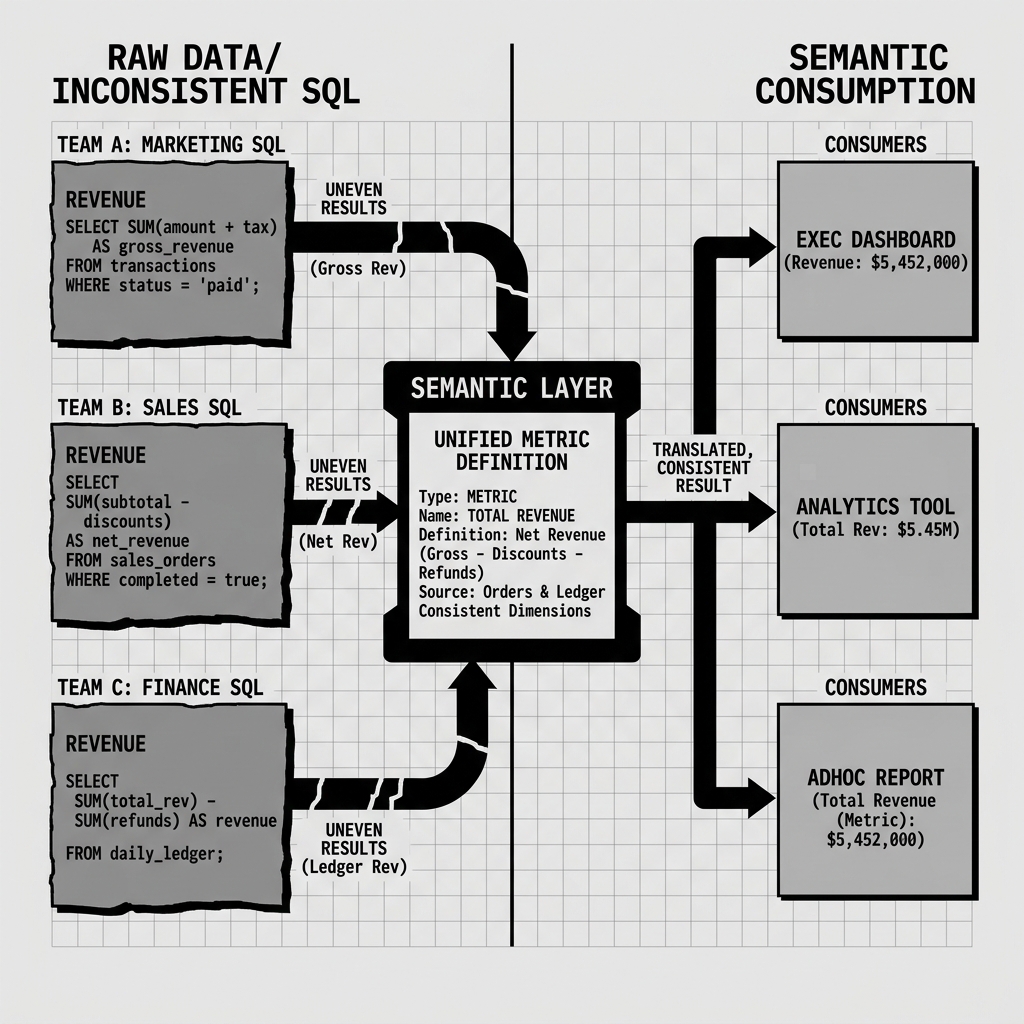
One of the most persistent and costly problems in enterprise analytics is metric inconsistency. Ask three different business teams what the company’s “revenue” was last quarter, and you will frequently receive three different numbers. The marketing team calculated it using gross revenue before refunds. The finance team used net revenue after all adjustments. The sales team used committed bookings, which includes deals that have not yet closed. None of them are wrong, exactly. They are each measuring something legitimate. But because every team wrote their own SQL against the raw data warehouse, applying their own business logic in isolation, the numbers diverged. Leadership ends up spending the first twenty minutes of every board meeting arguing over which number is correct instead of discussing strategy.
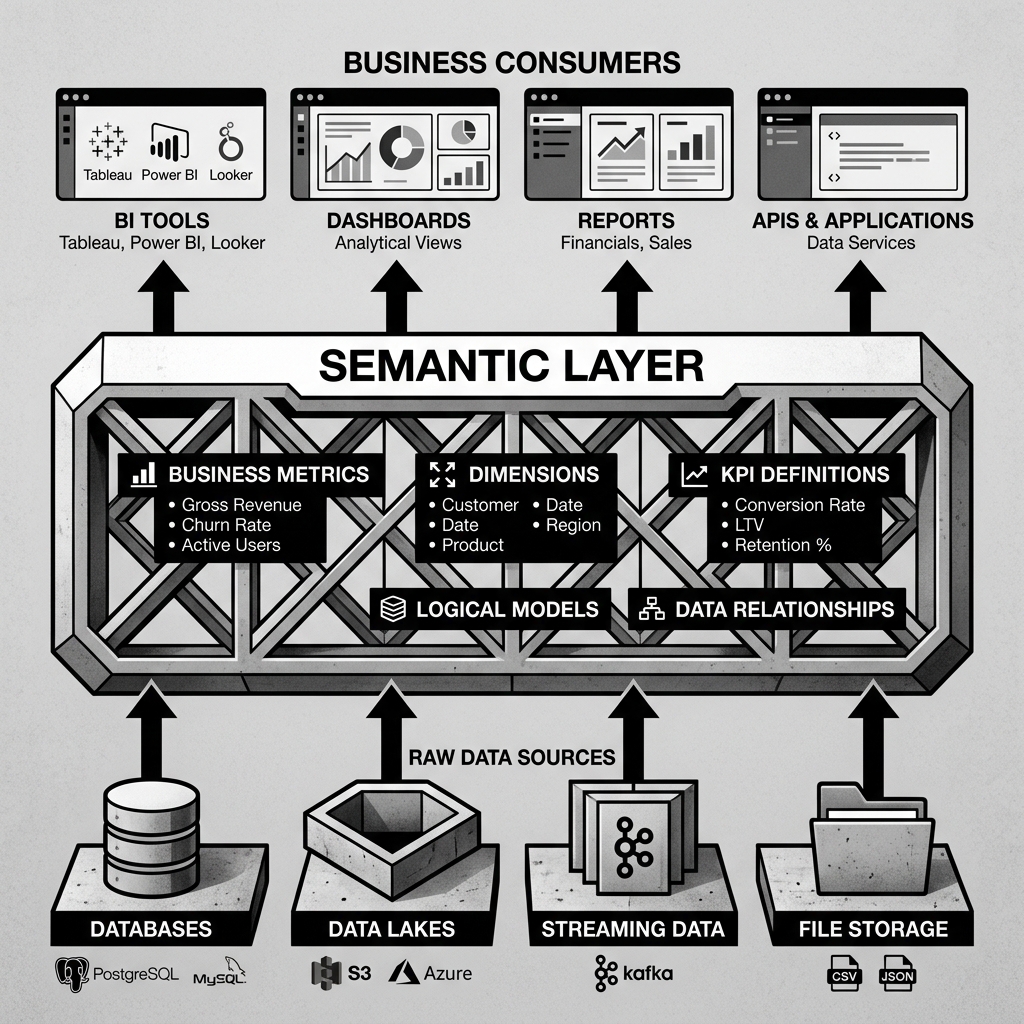
The Semantic Layer is the architectural solution to this problem. It is a centralized translation layer that sits between raw data sources and business consumers. Rather than allowing every team to write raw SQL directly against tables, the semantic layer maps raw physical data models to logical business concepts, such as “Revenue,” “Active Users,” or “Churn Rate.” Every consumer, from a BI dashboard to an ad-hoc SQL query to an API call, retrieves metrics through this shared definition layer. This guarantees that every team is working with the exact same calculation, the exact same business logic, every time.
What the Semantic Layer Contains
A semantic layer is not a single technology. It is a concept that can be implemented at different levels of the stack using different tools. However, all semantic layer implementations share a common set of components.
Metrics are the quantitative, calculated measures that represent business performance. A metric definition includes the name of the measure (e.g., “Monthly Recurring Revenue”), the underlying SQL expression that calculates it, the data source it draws from, and the dimensions it can be sliced by. Once defined, this metric can be referenced by any downstream consumer using just its name, without any knowledge of the underlying SQL.
Dimensions are the categorical attributes used to filter and group metrics. A “Region” dimension might map to a raw shipping_country_code column in the database, translating it into human-readable region names. A “Customer Segment” dimension might involve a complex case statement that groups customers into tiers based on their spending history.
Relationships define how different data entities join to each other. The semantic layer knows that the orders table joins to the customers table on customer_id, and that this relationship is a many-to-one. This allows users to query metrics like “Revenue by Customer Segment” without needing to write the join logic themselves.
Data Source Connections link the semantic layer to the underlying physical databases or data lakes. The semantic layer handles the physical query generation, translating the logical metric request into optimized SQL that runs against the actual database.
Diagram 1: Conceptual Architecture
Implementation Approaches
The semantic layer can be implemented at several different points in the data architecture, each with distinct tradeoffs.
At the BI Tool Level: Historically, most business intelligence tools like Tableau and Power BI implemented their own proprietary semantic layers. Tableau calls theirs a “Data Model,” and Power BI calls theirs a “Dataset.” These work well within a single tool’s ecosystem, but they create new silos. If the company uses both Tableau and Power BI, and both teams define “Revenue” slightly differently in their respective tools, the inconsistency problem moves from SQL to the tool level.
At the Data Modeling Layer: Tools like dbt (data build tool) implement the semantic layer as code in the transformation pipeline itself. Metrics are defined as SQL models in a version-controlled repository, and these modeled tables are what BI tools query. This approach ensures consistency because there is a single canonical table containing the calculated metric, but it requires rebuilding those tables on a schedule, which introduces latency between raw data changes and the available metric.
As a Dedicated Headless Semantic Layer: The most modern approach decouples the semantic layer from any specific BI tool or transformation framework. Tools like Cube.dev, AtScale, and Dremio’s Semantic Layer provide a standalone service that sits between the data warehouse or data lakehouse and all consumers. This headless approach is tool-agnostic, meaning any BI tool, API client, or LLM-powered agent can query the same metric definitions using SQL or a semantic API. This is considered the gold standard for enterprise consistency.
Diagram 2: Metric Consistency Flow
The Semantic Layer and AI Agents
The semantic layer has gained renewed importance with the rise of AI-powered analytics and agentic data systems. When an AI agent needs to answer a business question like “What was the conversion rate for the US market last month?”, it needs to know what “conversion rate” means in the context of that specific business. Without a semantic layer, the agent would need to understand the raw database schema, the join relationships, and the business rules for calculating conversion. Even with a highly capable language model, this is error-prone and inconsistent.
With a headless semantic layer in place, the AI agent can query a catalog of available metrics and dimensions, find the pre-defined “Conversion Rate” metric, and request it filtered by the “US” dimension for the previous month. The semantic layer translates that logical request into the correct, optimized SQL against the underlying data source. The agent gets a consistent, trustworthy answer without needing to understand any of the raw database mechanics.
This pattern, sometimes called “semantic-first analytics,” is becoming a standard architectural requirement for organizations building agentic data platforms on top of their data lakehouses. The semantic layer becomes the interface through which both humans and AI systems access organizational knowledge, providing a single, consistent, and trusted source of business truth.